Duct repair and duct sealing for Celina, TX homes, addressing leaks caused by shifting Blackland Prairie soil, builder installation quality, and the real cost of lost cooled air in a long, hot summer.
Celina Heat & Air repairs and seals residential ductwork throughout Celina, TX. Most calls trace back to one of two causes: Blackland Prairie clay soil shifting seasonally and stressing duct joints near the slab, or inconsistent sealing during original construction. A technician locates where air is escaping before recommending a targeted repair, a full sealing pass, or both.
We don't just work on HVAC systems in general. We know Celina specifically.
Blackland Prairie clay soil and how it stresses condenser pads and line sets
Celina's climate: 95–100°F summers and occasional hard winter freezes
All 12 Celina neighborhoods, from Light Farms to Downtown Celina
Built for one of the fastest-growing cities in the country (24.6% annual growth, Census Vintage 2025)
A few patterns are worth having checked, whether your home is new construction or has been through a few Celina summers already.
One or more rooms stay noticeably warmer than the rest of the house, especially rooms farther from the air handler
Your summer electric bill is higher than expected without another clear explanation
You notice dust, musty odor, or attic-smelling air coming through vents
Ductwork in the attic is visibly disconnected, kinked, or crushed where you can see it
The AC runs for long stretches without the house feeling like it's caught up
A newer home isn't cooling evenly despite a properly sized, well-maintained AC system
Ductwork doesn't get much attention until a room stops cooling properly, but in Celina there's a specific, regional reason duct problems show up here that has nothing to do with age or wear in the usual sense. Celina sits on Blackland Prairie clay, a soil type that expands when it absorbs moisture and contracts as it dries out. That seasonal movement doesn't just affect foundations in the abstract. It puts real, repeated stress on anything connected to or passing through the slab, and ductwork is one of the things most likely to feel it over the years.
This failure mode has nothing in common with the slow wear you'd expect from an old duct system in a mild climate. A duct joint or connection point near a slab penetration can start out perfectly sealed and still separate or crack years later, not because the material failed, but because the ground underneath it moved. Duct repair in Celina often means finding and fixing exactly that kind of foundation-related separation, not just replacing worn-out flex duct.
A duct joint near a slab penetration separating as clay soil shifts underneath it
The connection points where supply and return trunk lines pass through or near the foundation, whether that's at a slab penetration into an AC closet or a duct run beneath a portion of the home, are the places most exposed to this kind of movement. As the slab shifts seasonally with moisture changes in the clay beneath it, those connection points can gradually pull apart, crack, or separate at a seam that was never designed to flex. It's slow enough that homeowners rarely notice it happening, but the result is the same as any other leak: conditioned air escaping into a space it was never meant to cool.
A duct leak matters everywhere, but it matters more in a climate like Celina's than it would somewhere mild. With summer highs regularly hitting 95 to 100°F from July through August, the air conditioning system is working hard and running long hours across most of the day. Every bit of cooled air that escapes through a leaky duct joint before it reaches a vent is air the system paid to condition and then lost, and that system has to run even longer to compensate, which shows up directly on the electric bill, and can also show up as an AC repair call once the system has been overworking long enough. A leak into an attic space can also pull in dust and humidity, which is part of what makes indoor air quality and duct condition connected issues, not separate ones.
In a climate with a short cooling season, a duct leak is a comfort problem for a few months a year. In Celina, where the cooling season stretches across most of the year, that same leak is costing money on a much longer timeline. A leak that would be a minor inefficiency somewhere with mild summers becomes a meaningfully larger cumulative loss here, simply because the system is running so many more hours against it.
It's easy to assume that new construction means the ductwork is fine, but that's not always the case. In newer subdivisions like Light Farms and North Sky, ductwork is young in age, but installation quality still varies depending on which crew or subcontractor sealed the joints and connected the runs during the build. A duct system that was rushed through installation, or where mastic sealant was applied inconsistently at the seams, can leak air from day one, well before any foundation movement or normal wear ever comes into play.
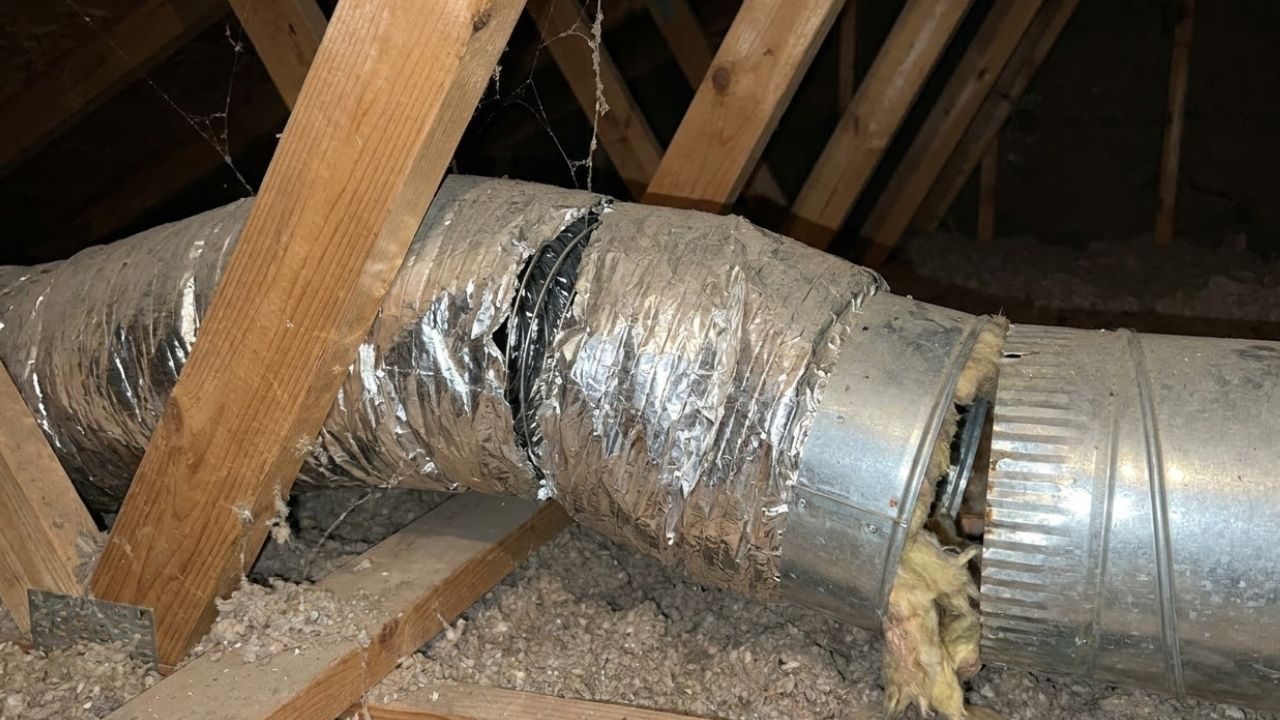
A duct joint in the attic showing an inconsistent seal, the kind of gap that leaks conditioned air well before any age-related wear sets in
This matters because homeowners in these newer neighborhoods often rule out duct issues simply because the house is new. Uneven cooling or a higher-than-expected summer bill in a Light Farms or North Sky home is just as often a builder-grade sealing issue as it is anything related to the AC system itself, and it's worth checking the ductwork specifically rather than assuming a young system means airtight ducts.
These two services overlap but solve slightly different problems. Duct repair generally means fixing a specific, identifiable issue: a separated joint at a slab penetration, a crushed section in the attic, or a disconnected run that's dumping conditioned air somewhere it shouldn't. Duct sealing is a broader process that addresses smaller leaks distributed across the whole system, sealing seams and connections with mastic or approved tape even where there's no single dramatic failure point, just accumulated air loss at dozens of minor gaps.
A duct system that has one major separation from foundation movement often also has smaller leaks throughout, especially if it's an older system or one where installation quality was inconsistent to begin with. Repairing the obvious problem without sealing the rest of the system can leave real efficiency losses in place. In a lot of Celina homes, the right approach is both: fix what's clearly broken, and seal the smaller leaks that are quietly adding to the summer cooling bill.
Connection points near the slab are where Blackland Prairie clay's seasonal movement shows up most directly, gradually pulling joints apart or cracking seals that were fine when the home was built.
In subdivisions like Light Farms and North Sky, inconsistent sealing during original construction can mean a young duct system already has meaningful leakage, independent of any soil movement or age-related wear.
Flex duct in the attic can get crushed under foot traffic during other work, kinked from being installed with too tight a bend, or knocked loose at a connection, all of which restrict airflow or leak conditioned air directly into the attic space.
Duct repair and sealing fall under the same Texas licensing rule as the rest of HVAC work: a current Air Conditioning and Refrigeration Contractor (ACR) license, issued by the Texas Department of Licensing and Regulation (TDLR), is required to do the job legally. Ductwork is part of the overall HVAC system, and improper repairs or sealing can affect airflow, system performance, and even safety in homes with combustion appliances sharing air handling space, so checking for that license before hiring is a reasonable precaution, not an excessive one.
We don't publish a flat number, since it depends on what the inspection finds. Here's what drives it.
One separated joint at a slab penetration is a targeted repair. Leaks distributed across the whole system call for a broader sealing pass.
Ductwork that's easy to reach in the attic costs less to work on than a run buried behind insulation or in a tight crawlspace.
A system with one major separation and also distributed smaller leaks needs both services, which costs more than either alone but addresses the full problem.
A crushed or kinked section may need a duct segment replaced outright rather than just resealed, which is a bigger repair than a joint separation.
We provide a clear, upfront price once we know where air is escaping, before any repair or sealing work begins.
Where leaks show up, and why, depends heavily on the home's age and construction.
In North Sky and similar young subdivisions, leaks usually trace back to installation quality rather than age or foundation movement.
Decades of seasonal slab movement plus original ductwork that may already have been undersized makes duct sealing a bigger factor in overall system performance here.
Longer duct runs feeding a second floor mean more joints and more attic footage exposed to crushing, kinking, and heat, more opportunities for a leak to develop.
A duct run extended to reach an addition is a common place to find a joint that was never properly sealed at the tie-in point.
More total ductwork and more slab penetration points mean more places for a leak to develop, which makes a full sealing pass more cost-effective than chasing individual leaks one at a time.
Light Farms and comparable communities share the same builder-quality-variance pattern: age alone doesn't rule out a sealing issue.
Duct repair and sealing isn't about a single equipment brand. It's about using the right sealing product and duct material for the job.
We match the repair material to the failure: a slab-penetration separation typically needs rigid or semi-rigid material rather than flex duct, while a distributed small-leak problem calls for a full mastic sealing pass rather than patching individual joints.
A proper visit starts with locating where air is escaping, not just assuming based on symptoms.
Tell us what's happening, whether it's uneven cooling, a higher bill, or visible duct damage you've spotted in the attic.
We inspect accessible ductwork, slab penetration points, and test system airflow to find out where air is escaping.
We explain what we found and whether it calls for a targeted repair, a full duct sealing pass, or both.
We fix or seal what we found and confirm improved airflow before we leave.
Need HVAC help? We're available 24/7.
Call Now: (323) 329-3203Celina sits on Blackland Prairie clay, which expands and contracts seasonally with moisture. That movement puts repeated stress on duct connections near the slab, particularly at penetration points into an AC closet, which can gradually separate or crack even years after a home was built.
Yes. Installation quality varies by builder and crew, even in newer subdivisions like Light Farms and North Sky. A duct system can leak from day one if joints weren't sealed consistently during the original build, independent of age or foundation movement.
It depends on the size and number of leaks, but in Celina's climate the impact is bigger than in a mild climate, since the AC runs long hours across most of the year. Air lost through a leaky duct means the system has to run even longer to compensate, and that adds up over a long cooling season.
Duct repair fixes a specific, identifiable problem, like a separated joint or a crushed section. Duct sealing addresses smaller leaks distributed across the whole system by sealing joints and seams, even where there's no single dramatic failure point. Many homes need both.
That's part of what a proper inspection determines. A system with one major separation from foundation movement often also has smaller leaks throughout, so we typically check the whole system rather than just fixing the obvious problem.
Yes. Duct repair and duct sealing in Texas fall under the same TDLR Air Conditioning and Refrigeration Contractor license required for other HVAC work, since ductwork is part of the overall system and improper repairs can affect airflow and performance.
It depends on the scope: one targeted repair costs less than a full sealing pass across a system with distributed leaks, and some homes need both. We provide a clear, upfront price once we know where air is escaping.
Including Light Farms, North Sky, and the rest of Celina, TX 75009.
We prioritize getting a technician to your door quickly, especially during peak summer and winter demand.
You'll know the cost before any work begins, so there are no surprise charges on your invoice.
We concentrate on Celina and the surrounding North Texas communities, so we know the area and its homes.
From Light Farms to Downtown Celina, we understand how housing age, soil, and construction style change what your system needs.
We explain what's wrong and what it takes to fix it, before any work begins.
HVAC failures don't wait for business hours, and neither do we.
Diagnostics and repair for underperforming or aging air conditioners.
New-construction hookups and first-time installs where no system exists yet.
Swapping out a failing, aging, or undersized system for one correctly sized to your home.
Ignition, control board, and blower repair for Celina homes.
New-construction hookups and replacements sized for our short heating season.
Repair and installation sized for Celina's mild winters and long cooling season.
For additions, conversions, and rooms without practical ductwork access.
Configured for your system and your household's actual routine.
Addressing summer humidity, mold risk, and spring allergens.
Spring AC tune-ups and fall furnace checks built around Celina's seasons.
24/7 emergency AC and furnace repair when it genuinely can't wait.
Builder coordination and post-closing upgrades for Celina's growing subdivisions.