Why Humidity Control Matters More Than Temperature in Celina Summers
When people think about summer comfort, they usually think about temperature. In Celina, humidity deserves just as much attention. Texas summers carry serious moisture along with the heat, and a home that's technically at the right temperature can still feel damp, sticky, and uncomfortable if the air handling isn't managing humidity correctly. That's not just a comfort issue. Excess indoor humidity is one of the main conditions that allows mold and mildew to take hold, particularly in newer, tightly sealed homes where moisture has fewer ways to escape.
This is where humidity control becomes a genuine health and property concern, not just a comfort upgrade. A home that traps humidity provides exactly the conditions mold needs: moisture, limited airflow, and warm temperatures for months at a stretch. Indoor air quality problems in Celina homes frequently trace back to humidity that was never properly managed, rather than a single dramatic cause.
How a filter captures particles as air passes through an HVAC system
Tight Building Envelopes and Trapped Moisture
New construction homes are built to be more energy efficient than older housing stock, which generally means a tighter building envelope: less air leakage, better insulation, more consistent sealing around windows and doors. That's good for energy bills, but it also means moisture that gets into the home, whether from cooking, showers, or simply humid outside air during the AC's off cycles, has fewer natural paths to escape. Without deliberate humidity control and proper ventilation, a tightly built new-construction home can trap more moisture than an older, leakier one, which is part of why indoor air quality and humidity control matter just as much in brand-new Celina subdivisions as they do in older homes.
Spring Allergen and Air Quality Concerns Specific to North Texas
Summer humidity isn't the only seasonal air quality challenge in Celina. Spring in North Texas brings its own combination of factors: pollen counts climb as trees and grasses come out of dormancy, and the same stretch of the year that brings severe weather season to this part of Texas also tends to stir up dust and airborne particulates. For a lot of Celina homeowners, spring is when indoor air quality complaints spike, well before summer humidity becomes the dominant issue.
Construction Dust in a Fast-Growing City
Celina's rapid growth adds a layer that doesn't apply everywhere. In actively-building subdivisions like Mustang Lakes and Lilyana, ongoing construction on nearby lots means dust and fine debris in the outdoor air, which finds its way indoors through open doors, returns, and whatever gaps exist in the building envelope. Homeowners in or near these fast-growing areas often deal with a combination of seasonal pollen and construction-related dust at the same time, which can make indoor air quality noticeably worse than in a more settled, fully built-out neighborhood during the same stretch of spring.
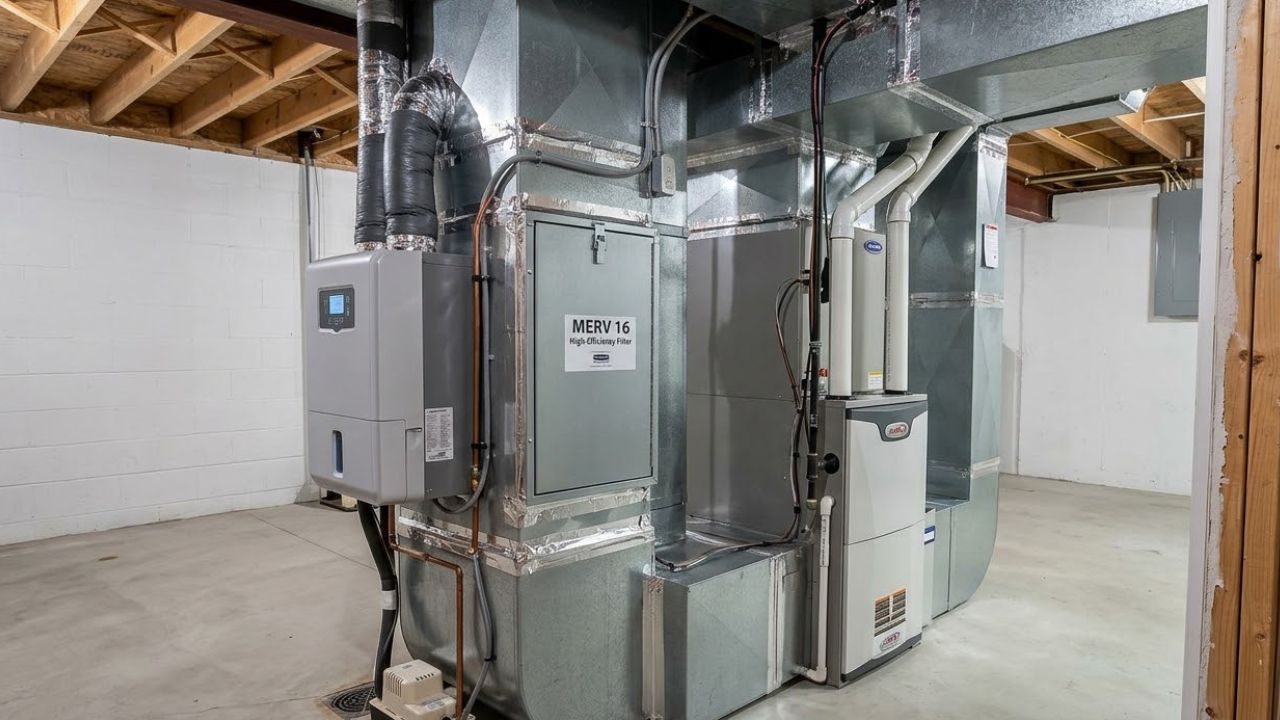
A whole-home dehumidifier and high-efficiency filter cabinet integrated with the existing ductwork
Common Indoor Air Quality Issues in Celina Homes
Excess Humidity and Mold Risk
Humidity that isn't properly controlled during Celina's long, humid summer creates the conditions mold needs to grow, particularly in less-visible spaces like closets, behind furniture, or inside HVAC ductwork itself. Addressing this is more about humidity control than air filtration, since removing moisture from the air is what prevents the underlying problem.
Pollen and Seasonal Allergens
Spring pollen from North Texas trees and grasses gets pulled indoors through open windows, doors, and the home's air intake, settling into carpets, upholstery, and ductwork where it continues circulating well after pollen season peaks outside.
Dust From Nearby Construction
In subdivisions still under active development, like Mustang Lakes and Lilyana, construction dust is a real, ongoing contributor to indoor air quality complaints, distinct from the general dust every home accumulates over time.
Poor Ventilation in Tightly Sealed New Construction
A well-sealed new-construction home holds in conditioned air efficiently, but without deliberate mechanical ventilation, it can also hold in humidity, cooking byproducts, and other indoor pollutants that would have found their way out of a leakier, older structure.
Humidity Control Solutions
Proper humidity control usually starts with the air conditioning system itself. An AC system that's correctly sized for the home removes humidity as part of its normal, longer run cycles, while an oversized system cools the air quickly and shuts off before it's had time to pull adequate moisture out, which is one of the more common reasons a home feels clammy even with the thermostat satisfied. Beyond correct sizing, a whole-home dehumidifier integrated with the existing HVAC system can handle humidity levels directly, particularly useful during the shoulder seasons when the AC isn't running long enough on its own to keep humidity in check.
Ventilation strategy matters too, especially in tightly sealed new-construction homes. Balanced mechanical ventilation brings in a controlled amount of fresh outside air while managing how much humidity comes with it, which is a more deliberate approach than relying on incidental air leakage the way older homes did by default.
Air Filtration and Purification Options
Filtration addresses a different part of indoor air quality than humidity control: particulates like pollen, dust, and other airborne debris rather than moisture itself. Upgrading from a basic filter to a higher-efficiency media filter captures more of these particulates without restricting airflow the way an incorrectly rated filter can. For homes dealing with heavier seasonal pollen loads or ongoing construction dust nearby, as in Mustang Lakes or Lilyana, a higher-capacity filtration setup integrated with the existing HVAC system is often more practical than relying on portable units room by room.
Indoor Air Quality Solutions for New Construction vs. Established Homes
The right approach depends on what kind of home you're in. In actively-building subdivisions like Mustang Lakes and Lilyana, the priority is usually managing construction dust and ensuring a tightly sealed home has deliberate ventilation and humidity control rather than relying on the building envelope to manage itself. In more established Celina neighborhoods, indoor air quality work is more likely to involve addressing an aging HVAC system's filtration capacity, checking ductwork for the kind of leaks that pull in dust and unconditioned air from the attic (see our duct repair and sealing page for that side of the problem), and confirming humidity control keeps pace as equipment ages, or as part of a broader AC replacement when the existing system is no longer up to the job.
Licensed Indoor Air Quality Services in Celina, TX
Indoor air quality equipment, dehumidifiers, ventilation systems, and filtration upgrades that tie into a home's HVAC system, falls under the same Texas licensing rule as the rest of HVAC work, since this equipment connects directly to the home's air handling and electrical systems. A current Air Conditioning and Refrigeration Contractor (ACR) license from the Texas Department of Licensing and Regulation (TDLR) is the credential to ask for before hiring anyone for this kind of installation.