Why Heat Pumps Are a Strong Fit for Celina's Climate
Heat pumps have a reputation problem in cold climates, and it's a fair one. In places with long, hard winters, a heat pump's heating efficiency drops as outdoor temperatures fall, and the system leans harder on backup heat to keep up. That's a real limitation. It's also almost entirely irrelevant in Celina.
Celina's winters are mild. Real heating demand is limited to a handful of weeks a year, and sustained sub-freezing stretches are the exception, not the rule. Summers are the opposite: long, hot, and humid, with the cooling side of the system doing the overwhelming majority of the work across the year. That combination, a short, mild heating season paired with a long, demanding cooling season, is close to the ideal climate profile for a heat pump. The system spends most of its life doing exactly what a standard air conditioner does, and the part of its job that's genuinely harder in cold climates barely gets tested here.
A heat pump reverses refrigerant flow to switch between cooling and heating mode
A Cooling-Dominated Climate, With Heating as the Exception
It helps to think of a heat pump as an air conditioner that can also run in reverse. In a climate where winter is the dominant season, that reversing capability gets pushed hard for months at a time, and that's where efficiency losses and backup heat reliance show up most. In Celina, heating mode gets called on far less often, and rarely for extended stretches. The system is doing cooling-duty work most of the year, which plays to what a heat pump does well, and only occasionally asked to do the harder job, which is when Celina's mild climate works in its favor rather than against it.
Morgan Lake Estates and Wellspring Estates: Where Heat Pumps Are Becoming the Default
In newer Celina subdivisions like Morgan Lake Estates and Wellspring Estates, heat pump systems are increasingly what builders install by default rather than a separate air conditioner and furnace. Both neighborhoods feature larger estate-style homes, and a single heat pump system that handles both heating and cooling is often a simpler, more space-efficient choice than two separate pieces of equipment, particularly when the home is also a good candidate for zoned comfort control across a bigger floor plan.
For homeowners in these neighborhoods, that means heat pump repair and heat pump installation are becoming a bigger share of the HVAC work in the area, not a specialty request. It also means the local service experience matters: a technician who mostly works on standard AC-and-furnace setups may not be as familiar with the reversing valve, defrost cycle, and backup heat components that are specific to heat pump systems.
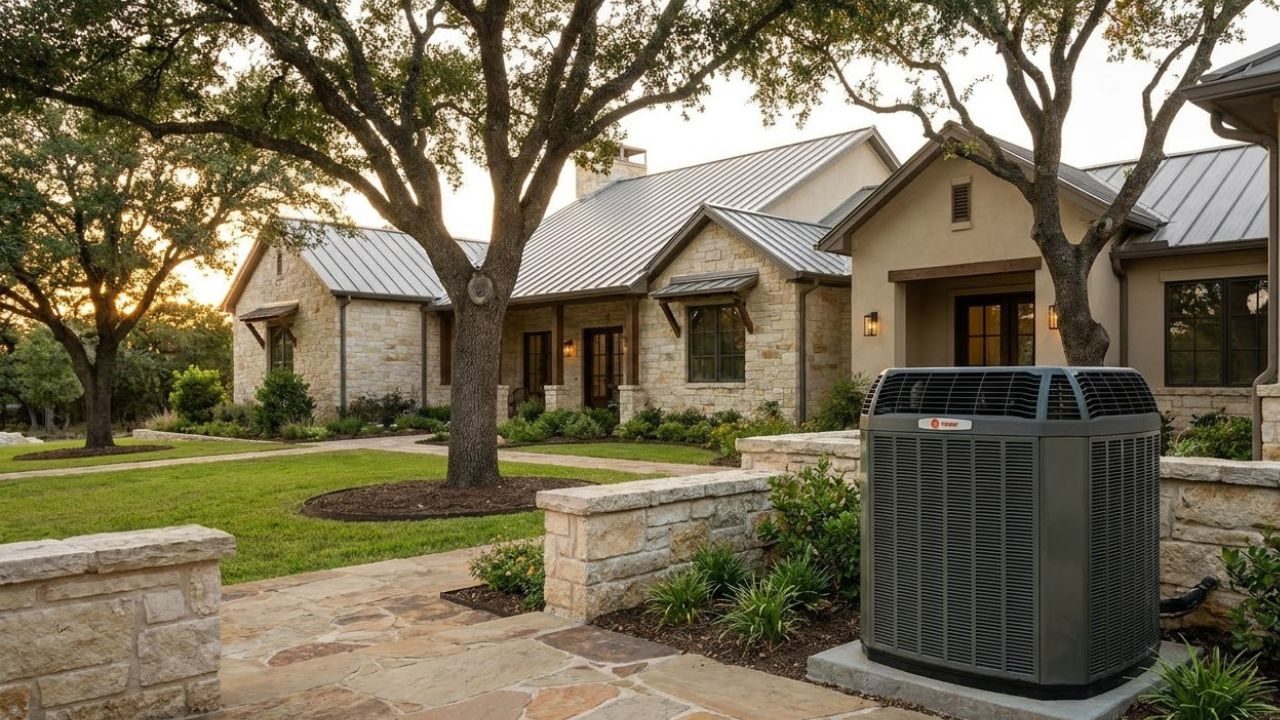
An outdoor heat pump unit at a larger estate-style home, the kind of property where a single system handling both heating and cooling makes sense
Backup Heat Strips and Celina's Occasional Hard Freeze
Most heat pump systems pair with electric resistance heat strips as backup, sometimes called auxiliary or emergency heat. These kick in when outdoor temperatures drop low enough that the heat pump alone can't keep up, or when the system needs a faster recovery than the heat pump side can deliver on its own. In Celina, that mostly means the occasional hard freeze night, not a routine winter occurrence.
Getting the backup heat configuration right matters in both directions. If the heat strips are set to activate too easily, the system relies on resistance heat, which is far less efficient than the heat pump itself, more often than it needs to, showing up as a noticeably higher electric bill on cold snaps. If they're not configured or sized correctly, the home can struggle to keep up on the rare nights that call for backup heat, which is exactly the wrong time to discover a configuration problem. Thermostat settings, the heat pump's balance point, and the heat strip's capacity all need to work together, not just be installed and left on factory defaults.
Why This Gets Overlooked
Because backup heat only matters on a handful of nights a year here, a misconfigured setup can go unnoticed for a long time. It's not until a genuine hard freeze arrives that a poorly tuned system either runs up an unusually high bill or fails to keep the house comfortable, and by then it's the worst possible time to sort it out.
Heat Pump Repair vs. Heat Pump Installation in Celina
These are related but different kinds of work. Heat pump repair means diagnosing and fixing a system that's already in place, whether that's a refrigerant issue, a reversing valve that's stuck in one mode, a defrost cycle that isn't clearing ice properly, or a backup heat strip that isn't engaging when it should. Heat pump installation means putting in a new system, whether that's a new-construction hookup in a subdivision like Morgan Lake Estates or Wellspring Estates, or a full replacement of an aging or underperforming system.
Installation carries an extra layer of complexity compared to a standard AC install, because a heat pump has to be sized for both the home's cooling load and its heating load, along with a backup heat strip sized to match. Getting the cooling side right but leaving the heating and backup heat sizing as an afterthought is a common way heat pump installations underperform once real winter weather shows up, even in a climate as mild as Celina's.
Common Heat Pump Repair Issues in Celina Homes
Reversing Valve Problems
The reversing valve is what lets a heat pump switch between cooling and heating mode. When it sticks or fails, the system can get stuck in one mode, blow the wrong temperature air, or fail to switch over when the thermostat calls for a mode change. This is a heat pump-specific failure that doesn't have an equivalent in a standard AC-only system.
Defrost Cycle Issues
Heat pumps periodically run a defrost cycle in cooler weather to clear ice buildup on the outdoor coil. A defrost cycle that isn't triggering correctly, or that runs too often or not often enough, can lead to ice accumulation that restricts airflow and reduces heating performance right when the system needs to be working its hardest.
Heat Strip and Backup Heat Failures
Because backup heat strips get used so rarely in Celina's climate, a failure can sit undetected for a long time. A strip that's failed or a control that isn't engaging it properly won't show up until a hard freeze calls for it, which is the worst time to find out.
Refrigerant and Electrical Wear from Cooling-Dominant Duty Cycles
Since a Celina heat pump spends most of its runtime in cooling mode, it experiences the same kind of wear a standard AC does from sustained summer heat: capacitors, contactors, and refrigerant charge are the most common points of failure, just like they are for straight air conditioning repair in this climate.
Heat Pump Installation Considerations
A proper heat pump installation starts with load calculations for both sides of the system, not just cooling capacity. That means accounting for the home's heat loss profile in addition to its cooling load, and sizing the backup heat strip to match realistic winter demand rather than defaulting to an oversized strip "just in case." In new-construction subdivisions where heat pumps are becoming the standard builder equipment, it's worth confirming that both sides of that sizing were calculated for the specific home, not just carried over from a standard subdivision spec.
Licensed Heat Pump Service in Celina, TX
Heat pump repair and installation in Texas fall under the same licensing rule as standard AC and furnace work: a current Air Conditioning and Refrigeration Contractor (ACR) license from the Texas Department of Licensing and Regulation (TDLR) is required, since heat pump work still involves refrigerant handling and electrical connections. It's worth asking specifically about hands-on heat pump experience too, not just the license itself, since standard AC and furnace background doesn't automatically cover heat pump components.