Smart thermostat installation for Celina, TX homes, compatible with both heat pump and traditional AC and furnace systems, and suited to a city with unusually high work-from-home rates.
Celina Heat & Air installs smart thermostats for Celina, TX homes, compatible with both heat pump and traditional AC-and-furnace systems. Installation means confirming the model matches the equipment's staging and wiring, addressing a missing C-wire where needed, and configuring scheduling around the household's actual routine, which matters more here than in a typical commuter suburb given how many Celina residents work from home.
We don't just work on HVAC systems in general. We know Celina specifically.
Blackland Prairie clay soil and how it stresses condenser pads and line sets
Celina's climate: 95–100°F summers and occasional hard winter freezes
All 12 Celina neighborhoods, from Light Farms to Downtown Celina
Built for one of the fastest-growing cities in the country (24.6% annual growth, Census Vintage 2025)
A few things about Celina change what a good thermostat setup needs to do.
Over a third of Celina's workforce works from home, per Census data, which most thermostat schedules don't account for
A fixed 9-to-5 schedule misses homes that are occupied unpredictably through the week
Heat pump systems need correct backup heat logic, not just a generic multi-stage setup
Traditional AC and furnace systems need correct staging and wiring configuration
Many smart thermostats require a C-wire, which older Downtown Celina homes may not have
The wrong thermostat model can look like it's working without controlling the system correctly
Most smart thermostat marketing leans on the same pitch: set a schedule, save money, done. That pitch assumes a fairly predictable household, gone during the day on a standard commute, home in the evening, weekends different from weekdays. Celina doesn't really fit that pattern. According to Census American Community Survey data, more than a third of Celina's workforce works from home, which is an unusually high share for a suburb this size. That changes what a thermostat schedule needs to do here.
In a typical 9-to-5 commuter suburb, a basic schedule covers most of the useful ground: setback during work hours, recovery before everyone gets home. In Celina, with a large share of residents working from home some or all of the time, home occupancy is a lot less predictable. A household might be fully occupied on a Tuesday and empty on a Wednesday, or occupied all day every day. A fixed weekday schedule built around a commute that doesn't happen misses most of the actual value a smart thermostat installation can offer here.
A generic thermostat wiring layout: R (power), C (common), Y (cooling), W (heat), G (fan)
This is where smart thermostat installation earns its name in Celina specifically, not as a generic upsell. Instead of relying on a fixed schedule that assumes everyone is gone from nine to five, a properly configured smart thermostat can use occupancy sensing, geofencing, or simply a schedule built around a household's actual routine rather than a commuter's. For a home office used three days a week and empty the other two, that's a meaningfully different setup than a rigid weekday-versus-weekend schedule, and it's the kind of configuration that gets missed when an installation treats every home the same way.
The efficiency argument for smart thermostats isn't wrong, it's just incomplete for a city like Celina. Saving money by not conditioning an empty home during standard work hours only helps if the home is predictably empty during those hours. For a large share of Celina households, it isn't. The more relevant value here is flexibility: a thermostat that adapts to whoever's home, rather than one that assumes a routine that doesn't match how the house is really used.
That might mean setting up occupancy-based adjustments instead of a rigid time-based schedule, configuring different profiles for work-from-home days versus commute days, or simply making sure the setup process asks about the household's routine instead of defaulting to a generic template. A smart thermostat installation that skips this conversation ends up with the same basic setback schedule you'd install in any commuter suburb, missing the part that matters for a lot of Celina homes.
Celina has a mix of both traditional AC-and-furnace setups and heat pump systems, and the two aren't interchangeable for thermostat compatibility. Getting this wrong during installation is one of the more common ways a smart thermostat underperforms, regardless of how well it's scheduled.
Heat pump systems need a thermostat that understands heat pump logic specifically, not just a generic multi-stage setup. That includes correctly configuring the balance point and backup heat behavior, since a thermostat that isn't set up properly can call for electric resistance backup heat more often than necessary, which is far less efficient than the heat pump itself. This matters in Celina because a lot of newer subdivisions increasingly use heat pump systems as the standard builder equipment, and a thermostat installed without accounting for that backup heat logic can quietly drive up winter electric bills on the rare cold snaps that call for it.
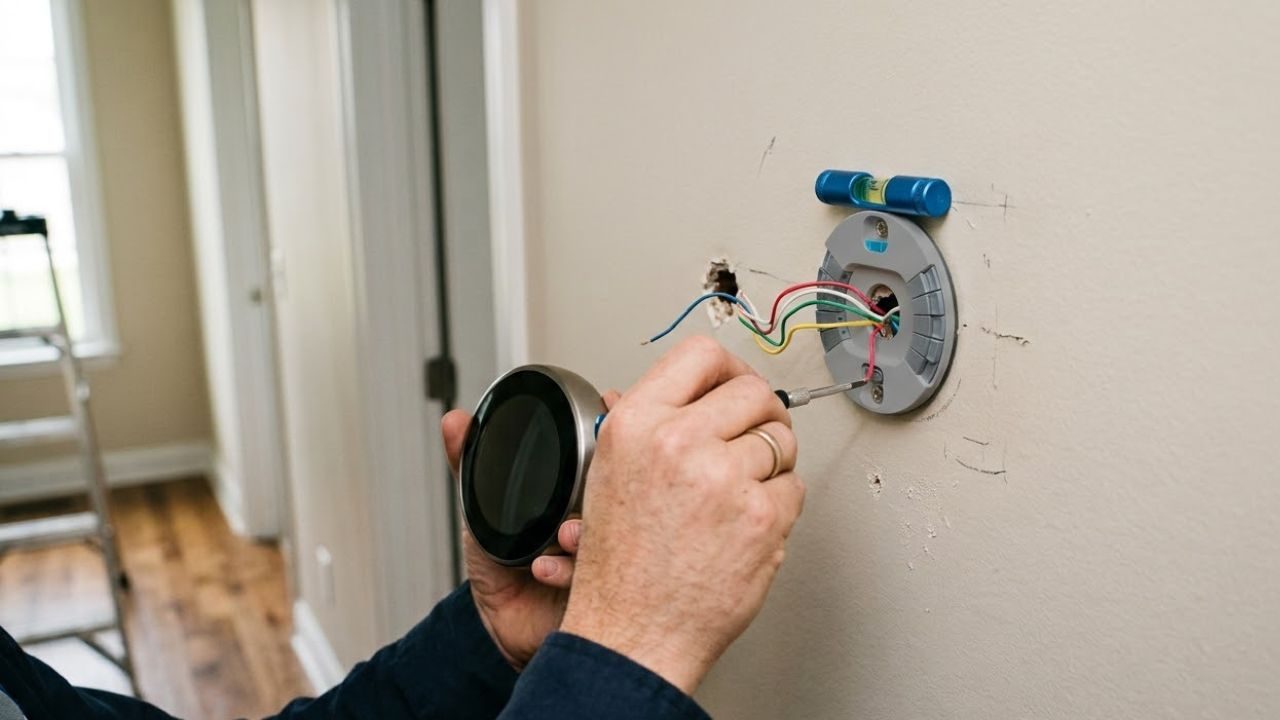
Connecting the low-voltage wiring during a smart thermostat installation, before the display is snapped into place
Standard AC-and-furnace systems have their own compatibility requirements, particularly around single-stage versus multi-stage equipment and how many wires the existing system provides. A smart thermostat installation on a traditional system is usually more straightforward than a heat pump setup, but it still requires confirming the equipment type and stage configuration match what the thermostat is built to control, rather than assuming any smart thermostat works with any system.
One detail that trips up a lot of smart thermostat installations, in Celina and elsewhere, is the C-wire. Many smart thermostats need continuous power to run their display and connectivity features, which requires a dedicated C-wire at the thermostat location. Older systems, and older homes generally, don't always have one run to the thermostat, which is more likely to come up in Downtown Celina's older housing stock than in newer construction where low-voltage wiring is typically more complete.
When a C-wire isn't present, there are a few ways to handle it, from running new wire to using a compatible adapter, but it needs to be addressed correctly during installation rather than discovered after the thermostat is already mounted and behaving erratically. A smart thermostat installation that skips this check is one of the more common reasons homeowners end up with a thermostat that reboots randomly or loses connectivity.
Beyond wiring, a proper installation confirms the thermostat model is rated for the specific equipment in the home, whether that's a single-stage AC and gas furnace, a multi-stage system, or a heat pump with backup heat strips. Installing a thermostat that isn't matched to the equipment can result in features that look like they're working but aren't controlling the system the way the display suggests.
Smart thermostat installation is lower voltage than refrigerant or gas line work, but it still connects to and controls HVAC equipment, which keeps it under the same Texas licensing umbrella as the rest of the system. A current Air Conditioning and Refrigeration Contractor (ACR) license, issued by the Texas Department of Licensing and Regulation (TDLR), covers correctly integrating a thermostat with multi-stage or heat pump control wiring, not just following generic instructions, so it's worth confirming before hiring anyone for the job.
We don't publish a flat number, since it depends on the equipment and wiring involved. Here's what factors in.
Different models vary in price. The right one depends on your system's compatibility requirements, not just features.
A home with an existing C-wire is a simpler install than one needing new wire run or a compatible adapter.
A single-stage traditional system is more straightforward to configure than a multi-stage system or a heat pump with backup heat logic.
A home with multiple thermostats or zoned systems takes more configuration time than a single-zone setup.
We provide a clear, upfront quote once we know your system and wiring situation.
Wiring and equipment compatibility change more with the home's age than its size.
Newer homes almost always have a C-wire already run, which makes installation more about system configuration than wiring work.
This is where the missing C-wire question comes up most, along with older single-stage equipment that needs simpler thermostat compatibility than a modern multi-stage system.
Zoned systems need multiple thermostats configured to work together, not installed independently as if each zone were its own home.
A single thermostat downstairs can misread how warm the upstairs is, which makes sensor placement, not just the thermostat model, part of getting the installation right.
A ductless mini-split typically uses its own remote or app control rather than a standard low-voltage thermostat, which needs to be accounted for during setup.
A large share of these households work from home, which makes occupancy-based scheduling more valuable here than the standard commuter-schedule default.
We install and configure the leading smart thermostat brands, matched to whatever HVAC equipment is already in your home.
A proper installation is configured around your system and your household's actual routine.
Tell us whether you have a heat pump, a traditional AC and furnace, or aren't sure, and how your household uses the home.
We confirm the thermostat model matches your equipment and check for a C-wire or a suitable alternative.
We install the thermostat and configure scheduling or occupancy settings around your household's actual routine.
We walk you through the setup so you know how to adjust it as your routine changes.
Need HVAC help? We're available 24/7.
Call Now: (323) 329-3203A typical smart thermostat schedule assumes people are away during standard work hours. With more than a third of Celina's workforce working from home per Census data, that assumption doesn't hold for a lot of households, so scheduling needs to account for less predictable occupancy instead.
Most will, but it needs to be configured with the right heat pump logic, including backup heat behavior, not just installed as a generic multi-stage thermostat. Getting this wrong can mean the backup heat strips run more than necessary.
The installation is usually more straightforward than a heat pump setup, but it still requires confirming the equipment's staging and wiring match what the thermostat is built to control.
That's common, especially in older homes. There are ways to address it, from running new wire to using a compatible adapter, but it needs to be handled correctly during installation rather than discovered afterward.
Yes, with the right setup. Occupancy sensing, geofencing, or multiple saved profiles can adapt to a household that doesn't follow the same routine every day, which is more useful in Celina than a single fixed schedule.
For thermostats connected to HVAC equipment, yes. It falls under the same TDLR Air Conditioning and Refrigeration Contractor license required for other HVAC-connected work, since it involves correctly integrating with the system's control wiring.
It depends on the thermostat model, whether a C-wire is already present, and how complex the system is, from a single-stage setup to a multi-stage or heat pump system. We provide a clear, upfront quote once we know your system and wiring situation.
Including Downtown Celina, Morgan Lake Estates, and the rest of Celina, TX 75009.
We prioritize getting a technician to your door quickly, especially during peak summer and winter demand.
You'll know the cost before any work begins, so there are no surprise charges on your invoice.
We concentrate on Celina and the surrounding North Texas communities, so we know the area and its homes.
From Light Farms to Downtown Celina, we understand how housing age, soil, and construction style change what your system needs.
We explain what's wrong and what it takes to fix it, before any work begins.
HVAC failures don't wait for business hours, and neither do we.
Diagnostics and repair for underperforming or aging air conditioners.
New-construction hookups and first-time installs where no system exists yet.
Swapping out a failing, aging, or undersized system for one correctly sized to your home.
Ignition, control board, and blower repair for Celina homes.
New-construction hookups and replacements sized for our short heating season.
Repair and installation sized for Celina's mild winters and long cooling season.
For additions, conversions, and rooms without practical ductwork access.
Finding and fixing air leaks from shifting soil and installation quality.
Addressing summer humidity, mold risk, and spring allergens.
Spring AC tune-ups and fall furnace checks built around Celina's seasons.
24/7 emergency AC and furnace repair when it genuinely can't wait.
Builder coordination and post-closing upgrades for Celina's growing subdivisions.