Why Mini-Splits Make Sense for Celina's Additions and Conversions
A lot of the ductless mini-split work we do in Celina has nothing to do with a failing central system. It's homeowners converting a garage into a home office, finishing out a bonus room, or adding square footage in established subdivisions like Sutton Fields and Twelve Oaks, and running into the same problem: the existing central AC and ductwork were sized and routed for the home as it was originally built, not for the room that's being added now.
Extending ductwork into a converted garage or a new addition sounds simple until you look at what it involves. The existing system usually wasn't sized with extra square footage in mind, so tying a new room into it can mean the whole system now has to cool more space than it was designed for, which shows up as weaker performance everywhere, not just in the new room. Running new duct into a converted garage often means cutting into finished walls and ceilings to route it, in a space that wasn't built with duct chases in mind. A ductless mini-split installation sidesteps both problems: it adds cooling and heating capacity to that one space without touching the existing central system's load or tearing into finished construction to get there.
A ductless mini-split system: an indoor head unit connected by a line set to an outdoor condenser
Why Extending Central Ductwork Often Doesn't Work in Established Homes
In an established Sutton Fields or Twelve Oaks home, the central system has usually settled into a stable, known load for years. Adding a room to that load without re-evaluating the whole system is how homeowners end up with a central AC that used to keep the house comfortable but now struggles across the board. A mini-split keeps the new space on its own dedicated equipment, so the addition doesn't quietly degrade comfort in the rest of the house.
Downtown Celina's Older Homes: Where Ductless Makes Even More Sense
Downtown Celina, centered on the historic square, has the city's oldest housing stock, much of it built before central air conditioning was standard or with ductwork that's undersized by today's standards. Retrofitting central ductwork into a home that wasn't designed for it is a much more invasive project than extending ductwork in newer construction, and the sealing work involved often overlaps with what a duct repair and sealing assessment would find. It often means running duct through spaces that were never built to accommodate it, with real limits on where duct can physically go without major renovation.
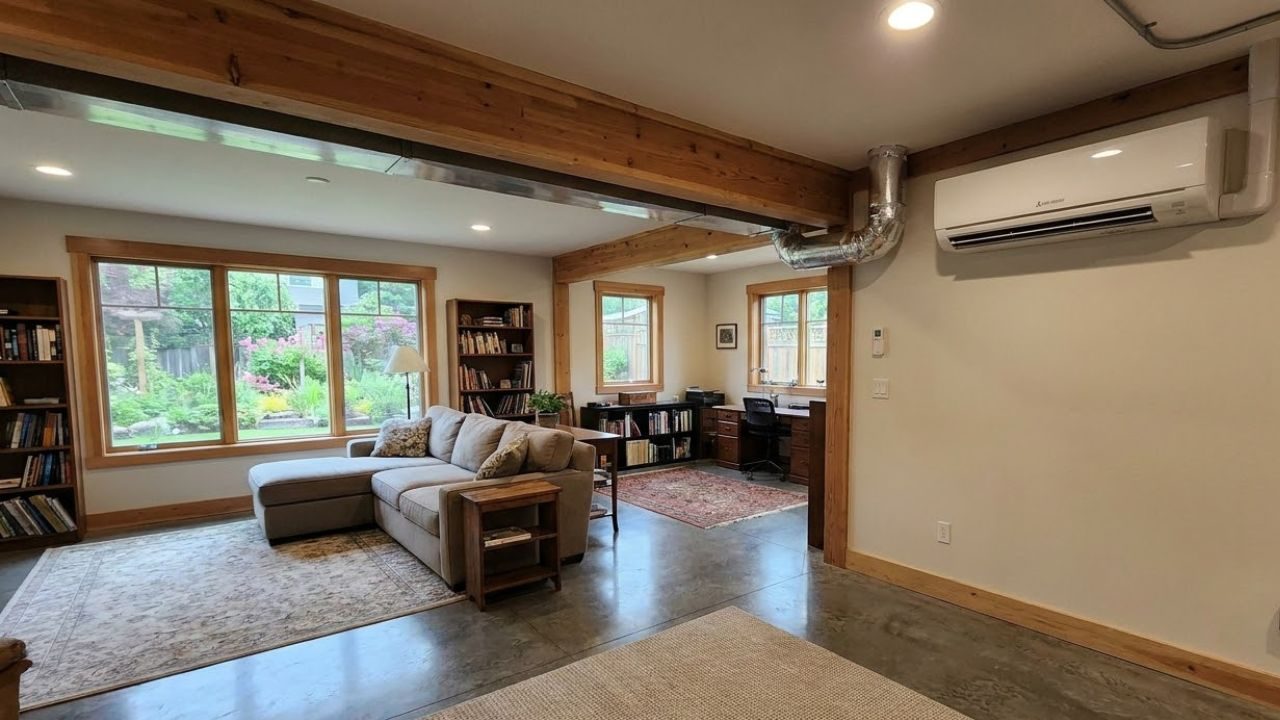
An indoor mini-split head unit mounted in a converted living space, connected by a small conduit rather than central ductwork
A ductless mini-split installation is often the more practical path in these homes, whether that's cooling a single room that the existing system never handled well, or building out a multi-zone system as an alternative to a full ductwork retrofit. Because a mini-split only needs a small conduit between the indoor and outdoor units, it avoids the extensive wall and ceiling work that a proper central ductwork retrofit would require in an older structure.
Efficiency Benefits for Celina's Long Cooling Season
Celina's cooling season runs long, with sustained heat from spring through the hottest stretch of summer. That matters for how a mini-split is built to operate. Most ductless mini-split systems use inverter-driven compressors, which modulate their output to match the actual cooling load rather than simply switching on and off at full capacity. Over a long cooling season, that steady modulation tends to run more efficiently than equipment that's constantly cycling on and off, especially in a space that doesn't need the same output all day.
Zone-specific cooling is the other efficiency angle that matters here. A mini-split installed in a home office or converted garage cools only that space, rather than running a central system to condition an entire house for the sake of one occupied room. Over Celina's long cooling season, that difference between conditioning one zone and conditioning the whole home adds up, particularly in spaces that only need cooling during specific hours, like a home office used during the workday.
Ductless Mini-Split Installation vs. Extending Central Ductwork
These solve the problem in fundamentally different ways, not just at different price points. Extending central ductwork means adding duct runs, potentially resizing or re-evaluating the existing system's tonnage, and routing new ductwork through the structure, which in an established or older home usually means opening up walls or ceilings. A ductless mini-split installation means running a small line set and conduit between an indoor head and an outdoor condenser, without touching the existing central system's ductwork or load calculation at all.
When a Mini-Split Makes More Sense Than a Central Extension
A mini-split tends to be the better fit for garage conversions, home additions, bonus rooms, casitas, and any space where the existing central system wasn't designed to reach. It's also frequently the more practical option in Downtown Celina's older homes, where extending real ductwork runs into physical and structural limits that newer construction doesn't have.
Common Ductless Mini-Split Installation Scenarios in Celina
Garage Conversions
A garage turned into a home office, gym, or living space rarely has any existing ductwork to tie into, and even if it did, a garage's insulation and exposure are usually different enough from the rest of the house that a dedicated mini-split gives more consistent comfort than trying to extend the central system's reach.
Home Additions and Bonus Rooms
New square footage added onto an established home in a neighborhood like Sutton Fields or Twelve Oaks is one of the most common reasons for a ductless mini-split installation. It lets the addition get properly sized cooling and heating without forcing the original system to carry more load than it was designed for.
Older Downtown Homes Without Adequate Ductwork
In Downtown Celina's older housing stock, a mini-split is often the difference between solving a comfort problem and living with a central system that was never going to reach every room evenly, without taking on a full ductwork renovation.
Choosing the Right System Size and Configuration
Ductless systems come in single-zone configurations, one outdoor unit paired with one indoor head, and multi-zone configurations, where one outdoor unit supports multiple indoor heads in different rooms. The right choice depends on how many spaces need coverage and how independently they need to be controlled. Sizing still matters here the same way it does for any HVAC equipment: an oversized mini-split short-cycles and struggles with humidity removal in Celina's climate just like an oversized central system does, so the indoor head needs to be sized to the specific room's actual load rather than rounded up "to be safe."
Licensed Ductless Mini-Split Installation in Celina, TX
A ductless mini-split installer in Texas needs the same Air Conditioning and Refrigeration Contractor (ACR) license, issued by the Texas Department of Licensing and Regulation (TDLR), that covers central AC and furnace work, since mini-split installation still involves refrigerant handling and electrical connections regardless of system type. Confirming that license before hiring is a straightforward way to know the person running your line set has the training the state requires for it.