Furnace Installation Looks Different Depending on Where You Are in Celina
There isn't really one typical furnace installation job in Celina. What the work looks like depends heavily on which part of the city you're in. In actively-building subdivisions like the Enclave at Legacy Hills and Lilyana, furnace installation usually means putting a heating system into a home that's never had one running, coordinated with the rest of the build, often alongside new-construction HVAC work more broadly. In older parts of the city, particularly around Downtown Celina, it more often means replacing a furnace that's reached the end of its service life in a home with existing ductwork, existing wiring, and existing constraints that a brand-new build simply doesn't have.
Both are legitimate furnace installation work, but they call for different judgment calls. A new-construction hookup is largely about getting the sizing and setup right from the start. A replacement in an older home is about figuring out what's already there, deciding what can be reused, and what needs to change to safely support a new system. Treating them the same way is how homeowners end up with heating that technically works but never quite performs the way it should.
How a gas furnace moves heated air through supply ductwork and pulls return air back in
Why the Distinction Matters
The difference isn't just procedural. A furnace installed as part of new construction is built into a home whose ductwork, insulation, and layout were all finalized around the same time as the equipment selection. A replacement furnace, by contrast, has to work with ductwork and a building envelope that may be twenty or more years older than the new equipment going into it. That gap is exactly where a lot of underperforming heating systems come from, when a modern furnace gets connected to ductwork that was never sized for it.
Why Furnace Sizing Matters More Than It Seems in a Short Heating Season
It's tempting to assume that in a place with a short heating season, furnace sizing is a minor detail. In practice, it matters just as much here as it does in a colder climate, just for different reasons. In a place with long, hard winters, oversizing a furnace is mostly a comfort and equipment-wear problem. In Celina, where real heating demand is limited to a handful of weeks a year, oversizing is more of an upfront cost and efficiency problem: you're paying for capacity that goes almost entirely unused, and an oversized furnace still short-cycles on the milder cold days that make up most of the season here, wearing out components faster while never running long enough to distribute heat evenly through the house.
A properly sized furnace, based on an actual heating load calculation for the home rather than a rule of thumb, costs less upfront than an oversized one, runs longer and more evenly on the moderately cool days that make up most of Celina's heating season, and still has the capacity to handle the occasional hard freeze the region does see most winters. "Just in case" sizing sounds like it's playing it safe, but in this climate it usually means paying more for a system that performs worse on the days you'll use it.
What Correct Sizing Looks Like Here
For furnace installation specifically, that means basing equipment selection on the home's actual heat loss calculation: square footage, insulation levels, window area, and air leakage, rather than defaulting to whatever size was used on a similar home nearby. It also means recognizing that the equipment doesn't need to be selected for the coldest theoretical night Celina could ever see. It needs to perform well across the much more common range of cold-but-not-extreme nights that make up the bulk of the season, while still having reasonable capacity in reserve for the occasional harder freeze.
New-Construction Furnace Installation in Growing Subdivisions
In subdivisions like the Enclave at Legacy Hills and Lilyana, where construction is still actively underway, furnace installation is part of a larger build process rather than a standalone repair-driven decision. The advantage here is that ductwork and equipment can be planned together from the start, which is exactly how a heating system should be designed. The risk is the same one that shows up across new construction in fast-growing areas: equipment specified once for a standard floor plan and then installed the same way across many homes, regardless of how a particular lot's orientation or layout might change its actual heating needs.
A furnace installed as part of new construction should still be sized to that specific home's heat loss profile, not just matched to whatever was used on the model or the house next door. Getting this right at the point of installation is far simpler and less costly than discovering years later that the system installed during construction was never quite right for the home.
Furnace Replacement in Downtown Celina's Older Homes
Downtown Celina, centered on the historic square, has the city's oldest housing stock, much of it built before 2000. Furnace replacement here is a different conversation entirely from new-construction installation. These homes come with existing ductwork that may be undersized, poorly sealed, or laid out for a heating system installed decades ago under very different standards. They may also have electrical and gas connections that need evaluation before new equipment can be safely installed.
A responsible furnace replacement in an older downtown home starts with assessing what's already there rather than assuming the old ductwork will work fine with new equipment. Reusing ductwork that was never adequate to begin with is one of the most common reasons a brand-new furnace still underperforms after installation. In some cases, a full heating system installation in one of these homes means addressing duct sizing and sealing alongside the furnace itself, not just swapping equipment in the same footprint as before.
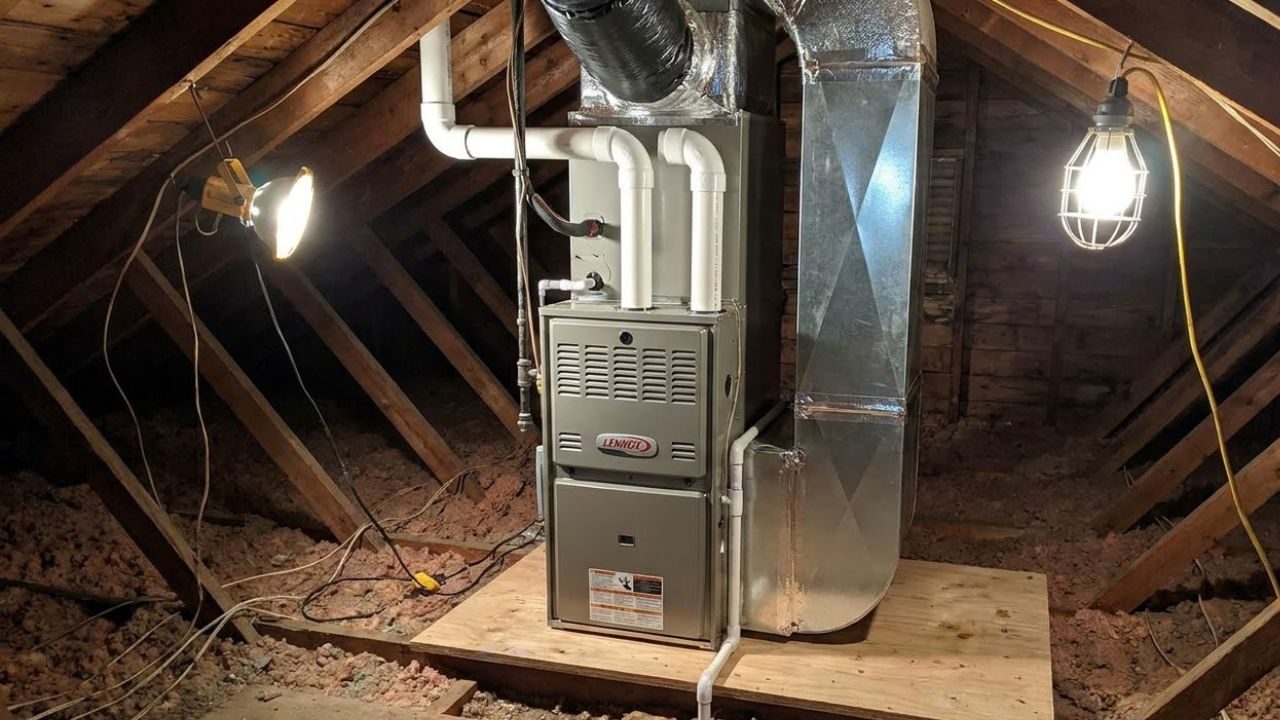
A completed furnace installation on an attic platform, with ductwork connected and ready for startup testing
The Safety Dimension of Replacement
Older furnaces reaching the end of their service life also raise safety considerations that don't apply to new construction: aging heat exchangers, older gas connections, and electrical wiring that may not meet current code. Part of a proper replacement job is evaluating these factors honestly rather than treating the job as a simple equipment swap.
Equipment Options
We install major residential furnace brands, including Carrier, Trane, Lennox, Goodman, Rheem, and Bryant, at a range of efficiency tiers from single-stage to variable-speed. For homes where a single system could reasonably cover both heating and cooling, a heat pump is worth comparing against a straight furnace, particularly given how mild and short Celina's heating season is.
Licensed Furnace Installation in Celina, TX
Furnace installation in Texas requires a current Air Conditioning and Refrigeration Contractor (ACR) license from the Texas Department of Licensing and Regulation (TDLR), and that requirement carries extra weight here: installation involves gas line connections, combustion venting, and electrical work where mistakes have real safety consequences. Ask to see the license before anyone starts the job, not after it's already underway.