Why Maintenance Timing Matters in Celina's Climate
HVAC maintenance advice is usually generic: get your system checked twice a year, spring and fall. In Celina, that timing isn't just a rule of thumb. It's shaped directly by the specific way this climate loads a home's heating and cooling equipment. Summers here run long and demanding, with sustained highs of 95 to 100°F from July through August. Winters are the opposite: mild most of the season, with real but limited heating demand concentrated into a much shorter stretch. That two-season pattern is exactly why a spring AC tune-up and a fall furnace check aren't interchangeable, generic maintenance visits. Each one is timed to catch problems before the specific kind of seasonal stress that follows it.
Celina's two-season maintenance rhythm: a spring AC tune-up ahead of summer, a fall furnace check ahead of winter
A Maintenance Rhythm Built Around Celina's Actual Seasons
A spring AC tune-up matters because it happens before the system faces its hardest test of the year, not after. Once June arrives and the AC starts running for hours at a stretch through peak summer heat, a small issue that a spring inspection would have caught easily can turn into a full breakdown in the middle of the season's worst weather. A fall furnace check works the same way in reverse: it catches ignition, control, and safety issues before the furnace is asked to perform reliably on the handful of genuinely cold nights Celina sees each winter, rather than discovering a problem in the middle of one.
Spring AC Tune-Up: Getting Ready for a Long Cooling Season
An AC system that's been sitting through a mild winter with light use can develop small issues that don't show up until it's put under real load. A spring AC tune-up is the point where those issues are cheapest and easiest to catch, well before Celina's summer stretch asks the system to run for hours a day, day after day, for months.
What a Spring AC Tune-Up Checks
A proper AC tune-up goes beyond a quick glance at the outdoor unit. It typically includes checking refrigerant charge, testing electrical components like capacitors and contactors that are especially prone to wear from sustained summer runtime, and inspecting the condenser pad and line set for the kind of stress that Celina's Blackland Prairie clay soil can put on outdoor equipment over time as the ground shifts seasonally. It also means confirming airflow at the vents matches what the system is producing, since a tune-up that only checks the outdoor unit misses problems that show up as uneven cooling indoors. A worn capacitor or a stressed line set found during a tune-up is a quick fix here; left alone, it's a future AC repair call, often at a worse time.
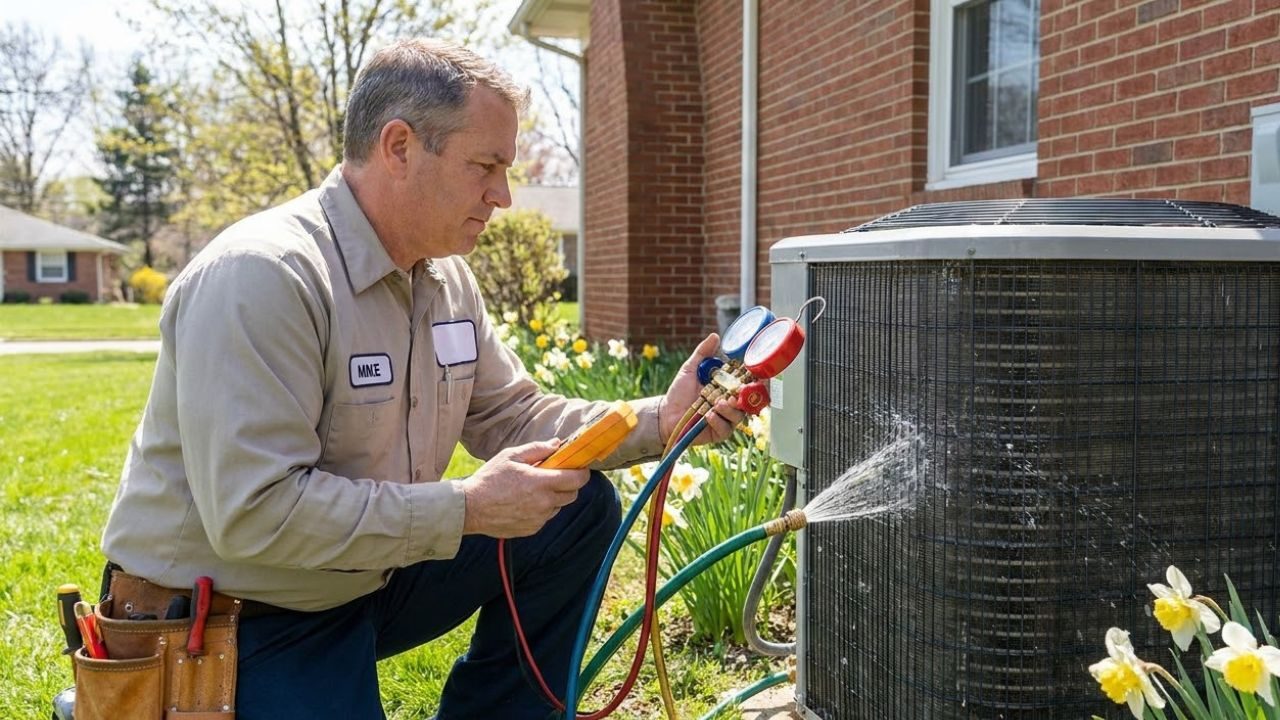
Checking refrigerant charge and pressure on an outdoor unit as part of a spring AC tune-up
Fall Furnace Check: Preparing for a Short But Real Heating Season
Furnaces in Celina live an unusual life. They sit mostly unused for around ten months of the year and then get asked to perform reliably during short, occasionally intense bursts of real cold. That pattern of long idle stretches followed by sudden demand is exactly what makes a fall furnace check valuable here, even in a climate where heating isn't the dominant season.
What a Fall Furnace Check Covers
A proper fall check tests ignition to confirm the furnace fires reliably on the first attempt, since components that sit idle for months are more prone to developing a fault that only shows up the next time they're asked to fire. It also includes checking the control board and thermostat communication, inspecting the blower for wear, and, for older systems, inspecting the heat exchanger for cracks or corrosion that could become a safety issue. Catching an ignition or control problem in a routine fall check is a much better outcome than discovering it during an actual hard freeze, when a home needs the heat working, rather than turning into an emergency furnace repair call in the middle of it.
Builder-Grade Equipment in Newer Subdivisions: Why Maintenance Matters Even More
Regular HVAC maintenance matters everywhere, but it carries extra weight in Celina's newer subdivisions. In neighborhoods like the Enclave at Legacy Hills and Morgan Lake Estates, HVAC systems were typically installed by a production builder working from a standard spec across the development, not custom-sized or maintained with the same attention a homeowner might give equipment they chose themselves. Without regular maintenance, that kind of builder-grade equipment can develop a shorter-than-expected lifespan, wearing out components sooner than the same equipment would in a system that received consistent tune-ups from the start.
It's easy to assume a newer system doesn't need attention yet simply because it's new. In practice, builder-grade equipment often benefits from maintenance earlier than a homeowner-selected system would, precisely because it was chosen for cost and code compliance across an entire subdivision rather than sized and specified for one particular home. Regular tune-ups are one of the more direct ways to catch that mismatch early and keep it from shortening the equipment's usable life.
A Different Maintenance Story in Downtown Celina
Downtown Celina's older housing stock tells a different story. These systems are typically well past any builder warranty and further along in their service life, which shifts the purpose of maintenance from protecting a newer system's expected lifespan toward getting the most reliable performance out of equipment that's already aging. In both cases, regular HVAC maintenance is doing real work, just aimed at a different stage of the equipment's life: extending a newer system's usable years in one case, and keeping an older system running safely and predictably in the other.
What Regular HVAC Maintenance Prevents
The value of consistent maintenance shows up in what doesn't happen: a breakdown during the hottest week of summer, an ignition failure during the year's one hard freeze, or a system that quietly loses efficiency for years without anyone catching it until the electric bill reflects it. An AC tune-up or furnace check that catches a worn capacitor, a refrigerant leak, or an ignition component starting to fail addresses the problem while it's still a minor, inexpensive fix, rather than after it's escalated into a full system failure at the worst possible time.
Licensed HVAC Maintenance in Celina, TX
HVAC maintenance, including AC tune-ups and furnace checks, falls under the same Texas licensing requirement as repair and installation work, since a maintenance visit involves handling refrigerant, testing electrical components, and, for furnaces, inspecting gas and combustion-related parts. A current Air Conditioning and Refrigeration Contractor (ACR) license, issued by the Texas Department of Licensing and Regulation (TDLR), is what to look for before letting anyone service your system.