Why New Construction HVAC Is Its Own Category in Celina
In most cities, new home HVAC installation is a small slice of the overall HVAC market, a handful of jobs scattered among a much larger volume of repair and replacement work on existing homes. Celina is different. According to Census Vintage 2025 population estimates, Celina posted a 24.6% annual growth rate, the fastest of any US city with a population over 20,000. That kind of growth doesn't happen without a constant pipeline of new homes being framed, roofed, and fitted with mechanical systems, which means new construction HVAC installation here isn't a generic add-on to a repair-focused business. It's a large, distinct category of work with its own timeline, its own coordination requirements, and its own set of decisions that don't come up on a typical replacement job.
The two main installation stages: rough-in during open framing, trim-out after walls are finished
What Makes New Construction HVAC Different From Replacement Work
Replacing a failed system in an existing home is a reactive process: something broke, and the job is to fix or replace it as cleanly as possible within the constraints of ductwork and equipment that already exist. New construction HVAC installation runs the opposite direction. The ductwork, equipment placement, and system sizing are all decided from a blank slate, coordinated with the home's framing schedule rather than fit around an existing house. That difference matters because it changes both the sequence of the work and who's setting the specifications, which in Celina's case is usually a production builder working across an entire subdivision rather than a single homeowner making individual choices.
Active-Building Subdivisions Driving Celina's New Construction Demand
Celina's growth isn't evenly distributed across a handful of finished neighborhoods. It's concentrated in subdivisions that are actively under construction right now, with new phases opening as earlier ones sell out and close. The Enclave at Legacy Hills and Lilyana are both examples of subdivisions where construction is ongoing, with new homes going up on a rolling basis rather than as part of a single completed development. Light Farms and Mustang Lakes, both established, larger subdivisions, still have ongoing phases under active construction, meaning new home HVAC installation is happening there alongside the day-to-day service calls for homes that have been occupied for years. That mix, of finished streets next to active job sites, is a pattern that shows up across most of Celina's larger subdivisions right now.
Why the Subdivision Matters for Installation Planning
Working in an actively developing subdivision means coordinating around a builder's construction schedule, not just a single address. Equipment deliveries, rough-in inspections, and final startup all have to line up with framing, insulation, and drywall phases across multiple homes at once, often on a schedule the builder sets rather than one negotiated house by house. That's a meaningfully different logistical picture than a single replacement job on an existing home, where the homeowner controls the schedule directly.
Working With Builders: Coordinated New Construction HVAC Installation
A production builder developing a subdivision like the Enclave at Legacy Hills or Lilyana typically works from a standardized HVAC specification applied across every home of a given floor plan, chosen to meet code and budget targets across the whole development rather than customized per house. That standardization is efficient for the builder, but it means the equipment going into a new home wasn't necessarily sized or selected with that specific home's layout, orientation, or the homeowner's preferences in mind. Coordinating directly with a builder on new construction HVAC installation means fitting into that process cleanly: showing up for rough-in on schedule, running duct and refrigerant lines to the builder's plan, and completing startup and testing before the home reaches its final inspection.
Rough-In, Trim-Out, and Startup: The New Construction Timeline
New construction HVAC installation happens in stages that don't exist on a replacement job. Rough-in comes early, while walls are still open, and covers duct runs, refrigerant line sets, and equipment pad placement. Trim-out happens later, after drywall, and covers registers, grilles, and the thermostat. Startup and testing come last, confirming the system runs correctly, holds the right refrigerant charge, and delivers airflow to every room before the home is turned over. Each stage has to line up with the builder's broader construction schedule, which is part of why new construction work requires a different kind of coordination than a same-day repair or a scheduled replacement.
Post-Closing Upgrades: When a Homeowner Wants More Than Builder-Grade
Not every new construction HVAC decision happens before closing. A meaningful number of homeowners in Celina's newer subdivisions choose to upgrade their system after they own the home, moving beyond the base builder-grade equipment that came standard with their floor plan. That might mean an AC replacement to a higher-efficiency unit, switching to a heat pump that handles both heating and cooling, adding zoning to a home where one thermostat is trying to condition rooms with very different sun exposure, or addressing an uneven airflow issue, sometimes tied to duct sealing or balancing, that shows up only after living in the house for a season.
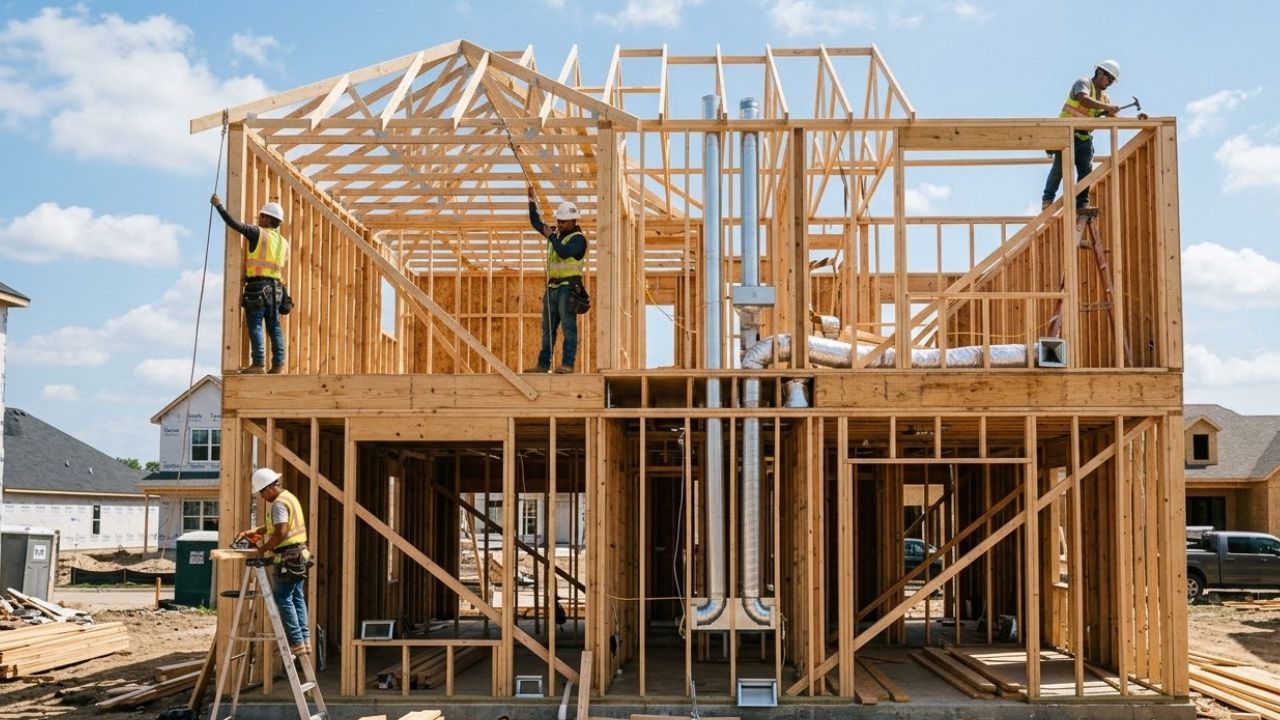
A new-construction home at the framing stage, with HVAC ductwork already routed through the wall cavities during rough-in
Why Homeowners Choose to Upgrade From Base Builder-Grade Equipment
Builder-grade equipment is selected to meet code and hit a target price point across an entire subdivision, not to be the best possible fit for one particular home. A homeowner who's lived through a first Celina summer with a builder-standard system sometimes finds that a second-floor bedroom runs warmer than the rest of the house, or that the base equipment doesn't quite keep up during the longest stretch of 95 to 100°F days in July and August. A post-closing upgrade is the point where a homeowner can address that gap directly, choosing equipment or a zoning setup sized for how the home performs rather than the standardized spec it shipped with.
Upgrading Before Move-In vs. After
Some homeowners catch this window before they've even moved in, during a builder's pre-closing walkthrough or design center process, and choose to upgrade equipment at that stage rather than living with the base system first. Others make the decision later, after experiencing a full cooling season or a hard freeze and deciding the base system isn't performing the way they'd like. Both paths are common in a market growing as fast as Celina's, where new homeowners are constantly moving through that same sequence of closing, moving in, and living with a system for the first time.
Licensed New Construction HVAC Installation in Celina, TX
New construction HVAC installation carries the same Texas licensing requirement as any other HVAC work: a current Air Conditioning and Refrigeration Contractor (ACR) license from the Texas Department of Licensing and Regulation (TDLR), covering everything from duct design and refrigerant line installation to final system testing. Whether the work is coordinated directly with a builder across a subdivision or contracted independently for a post-closing upgrade, that license is what to confirm before the work starts.
Why Licensing Matters More, Not Less, at This Volume
A city growing at Celina's pace means a high volume of new construction HVAC installations happening in parallel, often across several subdivisions at once. That volume makes licensing verification more important, not less, since a rushed or poorly supervised installation in a new home can create problems, uneven airflow, undersized equipment, or a duct system that doesn't match the home's actual layout, that don't show up until a homeowner has already moved in and lived with the system for a while.